Integrating the Gun Violence Vector Infographic Template into Data-Driven Workflows
Communicating sensitive and complex data regarding public safety requires a balance of statistical accuracy and visual clarity. The Gun Violence Vector Infographic Template serves as a specialized design asset for professionals tasked with translating dense datasets into accessible narratives. Rather than starting from a blank canvas, this template provides a structured framework specifically engineered for risk assessment, unintentional death statistics, and prevention workflows. It functions not merely as a decorative element but as a functional component in the information architecture of reports, educational materials, and policy presentations.
For marketers, educators, and analysts, the primary value lies in the template’s ability to standardize visual communication while maintaining flexibility. When dealing with topics as serious as gun violence, consistency in tone and layout is essential to maintain credibility. This vector-based resource allows teams to bypass the initial conceptualization phase and move directly to data population and narrative refinement. By utilizing pre-designed process timeline charts and linear iconography, creators can ensure that the focus remains on the message rather than the mechanics of graphic design.
Strategic Application Across Project Phases
The utility of this infographic template extends across the entire lifecycle of a communication project. Understanding where it fits within your existing workflow determines how effectively it can be leveraged. It is applicable during three distinct phases of production: planning, execution, and post-production adaptation.
Pre-Project Planning and Data Structuring
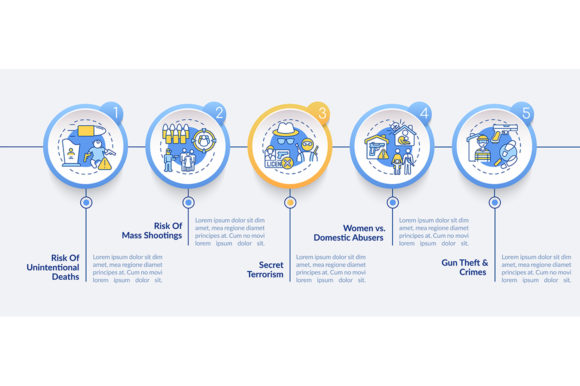
Before opening any design software, the template acts as a structural guide for data organization. The included 5-step data visualization layout forces content strategists to distill complex information into digestible segments. During the research phase, teams can use the template’s hierarchy to identify gaps in their current dataset. If the workflow layout requires five distinct stages of risk analysis but the current research only covers three, the template serves as an immediate diagnostic tool for content completeness. This prevents scope creep and ensures that the narrative arc is logical before design work begins.
Active Design and Stakeholder Review
During the creation phase, the Gun Violence Vector Infographic Template accelerates iteration cycles. Because the assets are fully editable vectors, stakeholders can review layouts with placeholder data to approve the visual flow before final numbers are verified. This separation of structure and content is vital for efficiency. Designers can adjust color palettes to match organizational branding or modify linear icons to better represent specific demographics without rebuilding the core geometry. This agility is particularly useful when working with cross-functional teams where feedback loops between subject matter experts and creative staff can often cause delays.
Post-Publication Adaptation and Archiving
After a report or presentation is delivered, the template facilitates long-term asset management. The availability of multiple file formats ensures that the work does not become obsolete. A finalized campaign can be repurposed for different channels by exporting specific elements. Furthermore, maintaining a master file allows organizations to update statistics annually without redesigning the entire visual system. This creates a consistent visual language over time, which is crucial for building recognition and trust in longitudinal studies or ongoing advocacy efforts.
Technical Compatibility and File Format Utilization
The ZIP file contains EPS, JPG, PNG, SVG, and AI formats, each serving a specific function within a professional ecosystem. Selecting the correct format is a matter of workflow efficiency and output quality.
- AI (Adobe Illustrator): This is the source file for deep customization. Use this when you need to alter the fundamental structure of the process timeline chart, change global colors, or replace linear icons. It preserves all layers and editing capabilities.
- EPS (Encapsulated PostScript): Ideal for cross-platform compatibility. If your team uses CorelDRAW, Affinity Designer, or older versions of Illustrator, EPS ensures the vector data remains intact. It is also the standard for professional print vendors producing large-format posters or brochures.
- SVG (Scalable Vector Graphics): Essential for digital-first workflows. SVG files retain crispness at any zoom level and are code-friendly. They integrate seamlessly into web platforms, interactive dashboards, and responsive presentations without increasing page load times significantly.
- PNG (Portable Network Graphics): Best for quick integration into documents, slide decks, or social media posts where vector editing is unnecessary. The transparent background support makes it easy to overlay the infographic onto varied backgrounds in Word, PowerPoint, or Canva.
- JPG (Joint Photographic Experts Group): Useful for low-bandwidth environments or email newsletters. While it lacks transparency and scalability, it offers universal compatibility for rapid sharing during draft reviews.
Implementing the 5-Step Data Visualization Workflow
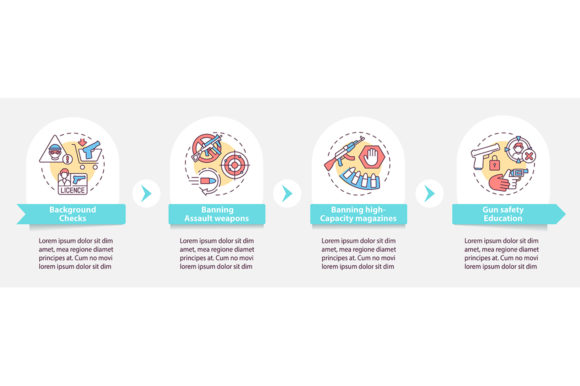
The core feature of this template is the 5-step data visualization structure. This is not arbitrary; it aligns with cognitive load theories regarding how audiences process sequential information. Implementing this effectively requires a disciplined approach to content mapping.
Step 1: Contextualization. The first node should establish the baseline. In the context of unintentional death risk, this might define the population scope or the specific timeframe of the study. Avoid jumping straight to alarming statistics; ground the viewer first.
Step 2: Identification of Variables. Use the second step to highlight contributing factors. The linear icons provided in the template are designed to represent abstract concepts like "storage," "training," or "legislation." Map these icons to specific variables in your dataset to create visual anchors.
Step 3: Interaction Points. Risk is rarely static. The third step should visualize where variables intersect. This is often where the process timeline chart proves most valuable, showing causality or correlation between behaviors and outcomes.
Step 4: Impact Assessment. Present the quantitative results here. Because the template uses vector shapes, charts can be resized proportionally to reflect data magnitude accurately. Ensure that the visual weight of this section matches its importance in the narrative.
Step 5: Mitigation or Conclusion. End with actionable insights or summary statistics. For sensitive topics, providing a resolution or a path forward is ethically important and improves audience retention. The template’s layout naturally guides the eye to this conclusion, reinforcing the takeaway.
Design Elements for Sensitive Topics
When addressing gun violence and unintentional death, aesthetic choices carry ethical weight. The template’s design elements are curated to support neutrality and clarity. The linear icon style avoids the visceral reaction associated with realistic imagery or silhouettes of weapons. This abstraction allows the audience to engage with the data analytically rather than emotionally shutting down due to graphic content.
Color management is equally critical. While the template may come with default colors, professionals should adapt the palette to suit the gravity of the subject. High-saturation reds can imply danger or alarm, which may be appropriate for warning signs but counterproductive for educational prevention material. Muted blues, grays, and teals often convey professionalism and calm analysis. The vector nature of the file allows for global color swaps in seconds, enabling rapid A/B testing of tonal approaches during stakeholder reviews.
Integration with Broader Toolsets
This template does not exist in isolation. It must interoperate with data analysis tools and content management systems. A common efficient workflow involves exporting cleaned datasets from Excel, Tableau, or R, and then importing those values directly into the AI or EPS file. Some advanced users utilize scripts to automate text replacement in Illustrator, linking the vector template directly to a CSV file. This reduces manual entry errors and speeds up the production of recurring reports.
For web-based projects, the SVG export can be embedded directly into HTML or manipulated via CSS and JavaScript. This allows for interactive elements where hovering over a step in the process timeline reveals additional metadata. Such integration transforms a static infographic into a dynamic exploration tool, significantly increasing user engagement and time-on-page metrics.
Quality Control and Ethical Considerations
Using a pre-made template introduces the risk of generic output. To maintain high standards, treat the Gun Violence Vector Infographic Template as a foundation, not a finished product. Customize the typography to match your publication’s style guide. Adjust the spacing to accommodate longer labels if necessary. Most importantly, verify that the visual metaphors used in the linear icons accurately reflect the cultural and social context of your specific audience.
Ethical representation is paramount. Ensure that the data visualization does not inadvertently minimize harm or sensationalize tragedy. The 5-step structure should be used to clarify, not to oversimplify complex systemic issues. Regular peer review of the visual output, separate from the data verification process, helps catch unintended biases or confusing layouts before publication. By combining the technical efficiency of vector assets with rigorous editorial oversight, professionals can produce work that is both visually compelling and socially responsible.